
There is a specific kind of silence that only exists in a library filled with people buried in books. It’s a heavy, pressurized quiet, broken only by the scratching of pens and the low hum of the air conditioner.
I was in the middle of my lunch break (the one hour of the day where my brain is allowed to stop memorizing facts and start breathing). As usual, I was seeking refuge in my “comfort loop”: watching sitcoms on repeat. This time, it was Brooklyn Nine-Nine.
I was halfway through the episode “Kicks” (S5, E3) when I saw it. On a gritty New York sidewalk, there was a chalk grid. Adrian Pimento, the show’s most unhinged detective, was frantically hopping through it.
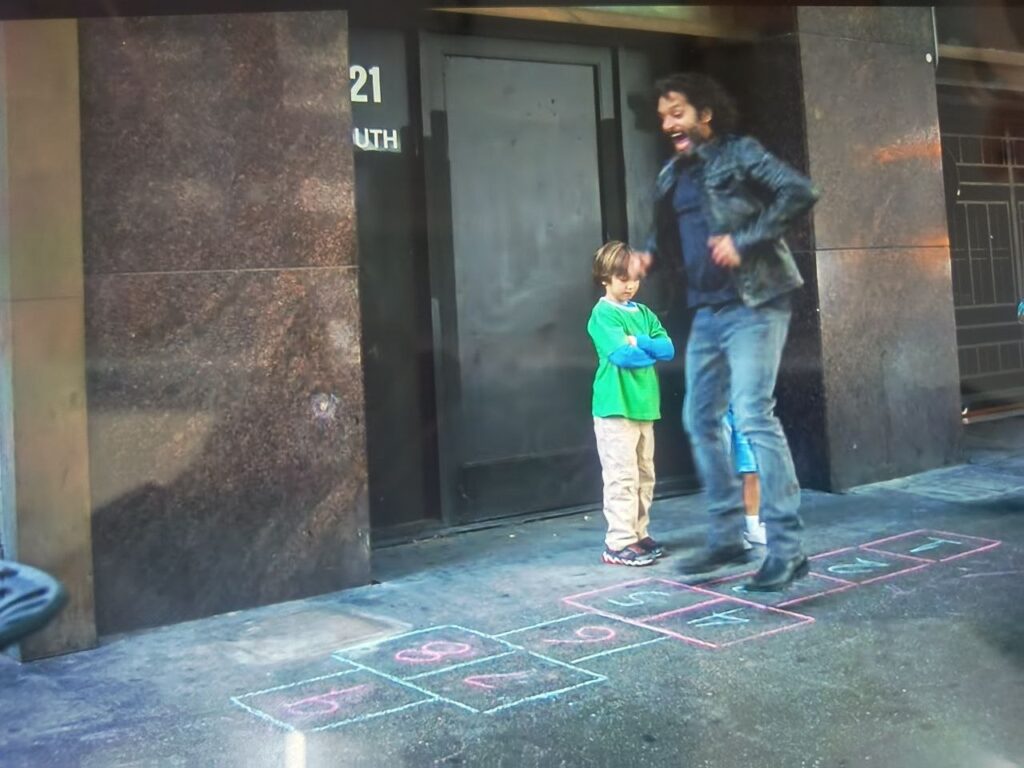
“What the F… no way that’s true!”
The words left my mouth before I could catch them. In a library, a whisper sounds like a shout. The row of students in front of me turned in unison, faces shifting from intense focus to confused annoyance. I did the awkward “Sorry” wave (the universal sign for I’m not crazy, just surprised) and lowered my head.
But my heart was racing.
I wasn’t looking at a New York sidewalk anymore. I was looking at a dusty backyard in my village. I wasn’t looking at Adrian Pimento. I was looking at my seven-year-old self, sitting on the sidelines, watching my sisters play.
In my village in Karnataka, we call it Kunte Bille.
I must have been six or seven years old the first time I played. Back then, we had a joint family. In our backyard, my cousin sisters would gather and draw the grid with chalk or a stick. I’d sit there for what felt like hours, just watching.
One day, one of my sisters turned to me. “Wanna play?”
I’d been waiting for that question.
They tried to explain the rules. I cut them off. “I’ve been watching long enough. I know how to play.”
I didn’t, really. But I wanted to seem confident.
My first attempt, I made it through three squares. Level 3. I felt good. I was having fun.
My sisters gave me a look I didn’t understand at the time. It was the kind of look that said: He’s a small kid. Let him have his moment.
It took me a while to realise they’d been letting me win.
The moment of truth came when we teamed up to play against the others. Suddenly, I wasn’t just hopping through squares on my own. I was part of a strategy. And that’s when I saw a completely different version of my sister.
She completed all the levels in one go. Flawless. If I made even the smallest mistake, she’d snap at me. The pressure was real.
I remember thinking: Wow. Where was all this before?
After we won, my sister boasted to the others: “I won with SAM on my team.”
I was happy. We’d won, hadn’t we?
Looking back now, it feels funny. Maybe a little harsh. She was implying I was a weak player. But I didn’t understand that then. I was seven. All I knew was that we’d won, and I’d been part of it.
Over the years, though, I got better. By fifth standard, I was good enough to beat them fair and square.
The first time I won, my sister acknowledged it. Then she smiled and said, “I taught you well.”
But even from the beginning, there was a tension I didn’t fully understand.
My mother and aunts would watch me play and say, almost reflexively: “Are you a girl? Why are you playing that?”
They didn’t say it to be cruel. It was just the way things were. To them, the grid was a “girls’ space,” as if hopping on one leg required a specific set of chromosomes.
I never argued. I just ignored them and kept playing.
But then my cricket buddies started showing up. They’d come to our house to invite me to play, and they’d see me mid-game with my sisters. The teasing was immediate. “Playing with the girls again?” they’d say, half-laughing, half-mocking. Some of it was playful. Some of it wasn’t.
As soon as they arrived, I’d leave the game halfway through and go play cricket. My sisters were annoyed at first. Sometimes they’d make me stay. But eventually, it became routine, and they let it go.
The thing is, no one ever questioned why it was labeled a girls’ game.
It was just accepted as fact. Mostly girls played it, so it must be a girls’ game. Simple as that.
But the reality of the game itself? That was anything but simple.
To play Kunte Bille properly, you needed the right stone. You couldn’t just pick up a random pebble. We would go on expeditions across the village to find the perfect bille (usually a flat, heavy piece of a broken roofing tile). If there was a construction site nearby, that was a goldmine.
But finding the tile was just the start. You had to shape it. We’d take another stone and chip away at the edges until we had something close to what we wanted. It took time. We kept spares, because if your bille shattered mid-game, you couldn’t just stop and make a new one.
All that work. For a “girls’ game.”
No one ever pointed out the irony.
The game itself wasn’t gentle, either.
We played barefoot on rough ground. Open village roads. The heat of the sun on the stones. The grit under our soles. One wrong move and you’d scrape your skin. I’ve seen my sisters fall. I’ve fallen. Sprained ankles weren’t uncommon.
There was a variation of the game where, instead of picking up your bille at each square, you had to kick it forward while hopping. If you kicked wrong on that rough surface, or landed badly, you could tear the skin on your foot.
It happened to me. It happened to my sisters. No one was immune.
But when we got hurt, it was treated like a normal game injury. No one said, “See? This is why boys shouldn’t play.” It was just kids being kids.
And yet, boys still weren’t supposed to play. Because it was a “girls’ game.”
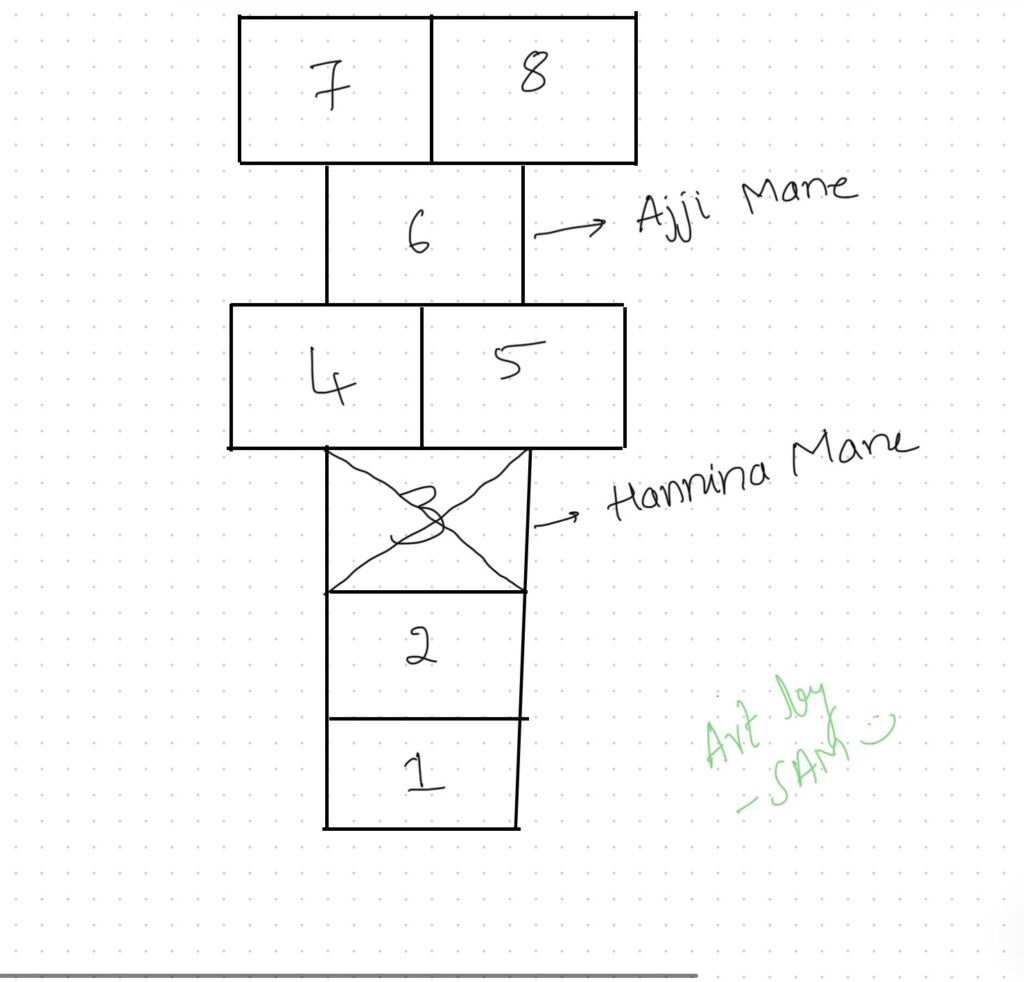
The grid had eight numbered squares. The tricky part was square 6, Ajji Mane (Grandmother’s House). You had to land your bille there with precision. If it bounced out or caught an edge, your turn was over.
But the real prize was square 3, Hannina Mane (Fruit House). If you made it through the entire cycle without a single mistake, you got to stand with your back to the grid and throw your bille blindly over your shoulder. If it landed inside a square, you “owned” it. You’d draw a massive X across it, and from that point on, everyone else had to hop over your claimed territory.
I watched my sister do it in one try. She didn’t just hop. She flowed. Her bille hit the target with a precise clack on the first attempt. She owned that square before I could even find my balance.
Sitting in that library, I stopped the episode. I signed an apologetic wave to the people still glaring at me, pulled out my phone, and started googling.
I didn’t even know the word “hopscotch” yet. I searched: Kunte Bille history.
When I found out it was called hopscotch everywhere, and saw the Brooklyn sidewalk wasn’t an anomaly, I felt a strange mix of relief and surprise. This wasn’t just ours. It never had been.
And then I found the Roman connection.
This “girls’ game” (the one boys got teased for playing, the one that required forty-five minutes of stone-carving and left us with torn skin and sprained ankles) was originally a military training drill. Roman legionnaires hopped through massive grids in full armor to build the explosive leg power needed for cross-continental marches. The children of the Empire watched the soldiers and recreated the drill at a smaller scale. Over centuries, it traveled across continents, adapted, survived.
And somehow, somewhere along the way, it became a “girls’ game.”
I sat there, staring at my phone, trying to process it.
How does a Roman military drill become a “girls’ game”?
I think it happened through what I call the “Geometry of the Home.”
Here’s what I mean.
Boys were pushed toward expansive sports. Cricket requires a field. Football requires open ground. These games demanded space, visibility, the kind of territory that belonged to the public world. Streets. Playgrounds. Open lots.
Girls didn’t get that space.
They got the porch. The backyard. The narrow strip of concrete outside the house. The leftover square footage that no one else wanted.
And so, the games adapted.
Kunte Bille only needed a small, flat surface and a bit of chalk. You could play it in a corner. You could play it between two parked scooters. You could play it on a strip of ground barely wide enough for one person to hop through.
It wasn’t that the game required less skill, or less toughness, or less endurance.
It required less space.
And because girls played it (not because it was easier, but because it fit in the spaces they were allowed to occupy), it became a “girls’ game.”
The logic was backwards. We looked at who was playing and decided that must mean the game itself was gendered. We didn’t ask why girls were playing it, or why boys were pushed elsewhere.
We just accepted it.
And once something gets labeled, the label sticks. Boys started getting teased for crossing that invisible line. Mothers started asking, “Are you a girl?” And the game that had once trained soldiers became something boys were supposed to outgrow.
It wasn’t about the game. It was about the space. And we convinced ourselves the space determined the gender.
I never finished that episode of Brooklyn Nine-Nine. I just sat there in the library, thinking about my seven-year-old self sitting in the backyard, waiting to be invited in.
I thought about my sisters letting me win, then teaching me, then finally acknowledging when I got good.
I thought about the bille I’d carved with my own hands, the one that shattered mid-game and left me scrambling for a spare.
I thought about the skin I’d torn, the falls I’d taken, the precision required to land that stone in Ajji Mane without touching the edge.
And I thought about the fact that all of it (the skill, the toughness, the risk, the strategy) somehow got labeled as “not for boys.”
We decide what belongs to whom, not based on what the game actually requires, but based on who’s playing it and where they’re allowed to play.
And that’s the real lesson of Kunte Bille.
Not the game itself. Not the history. Not even the shock of seeing it on a Brooklyn sidewalk.
It’s the reminder that the lines we draw (the ones that say “this is for you” and “this is not for you”) are just as arbitrary as the chalk grids we hop through.
The only difference is, in the village, if you stepped on a line, you just laughed and started again.
In the real world, the lines are harder to cross.
I’d love to hear from you: What’s your name, where are you from, and what do you call this game in your region? What’s your version of Hannina Mane (the Fruit House / the square you claim)? Drop it in the comments.
Keep the Story Going ☕
What a brilliant perspective and write up 👏🏽
Thoroughly enjoyed reading it. Thank you for sharing!
In our childhood we called it “tikker billa” and we used to say at each hop “langdi, langdi, tubajja, langdi, tubajja”
#Nostalgia
Thank you! ‘Tikker billa’ and that rhythm, love it. Same game, just different names.
I would have never got to know about this game, if not for your essay. In my area we call it Kit-Kit, and yes it’s considered as a girl’s game. I wish more people knew about this perspective:)
Aww!!!!, that means a lot to me. Thanks so much for reading and for sharing your perspective too.
Brilliant observation! Brought back memories from childhood as well
Thanks!!!